By Rachel Simmons October 7, 2026
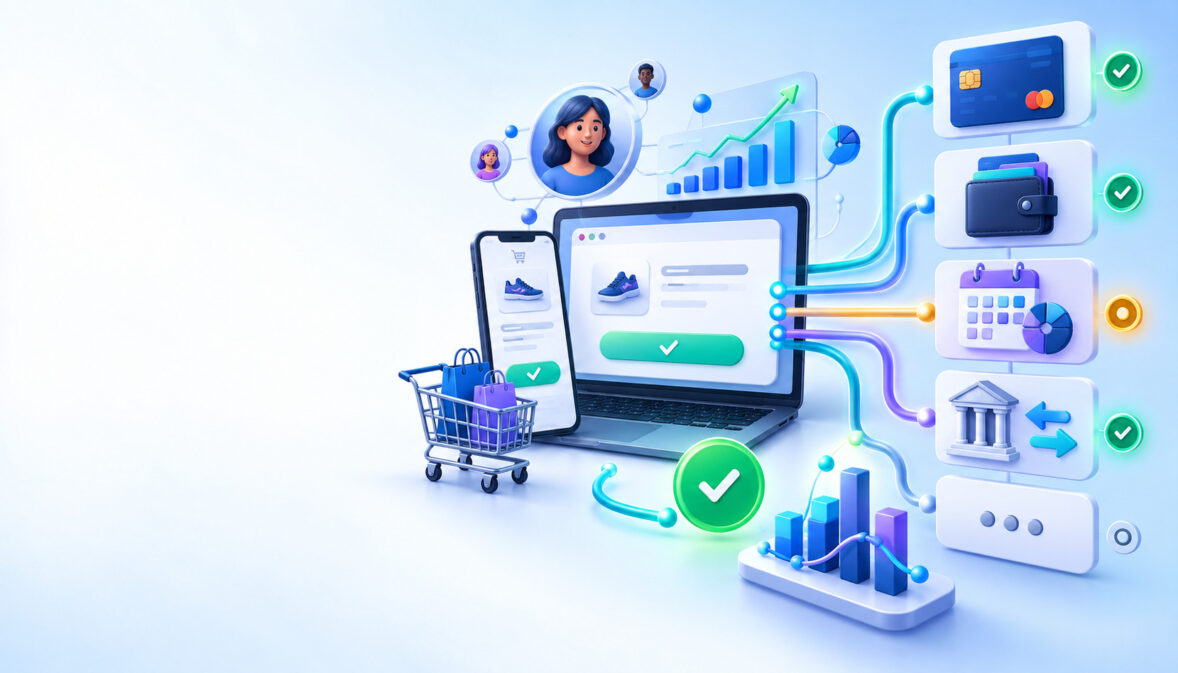
The best checkout payment method mix is the smallest set of options that covers how your most valuable customers prefer to pay. Keep cards as a dependable base, surface eligible digital wallets where they remove friction, add BNPL when financing improves higher-ticket conversion, and offer bank payments where customer type, transaction size, and economics justify them.
A checkout should not look like a directory of every payment product your gateway supports.
The strongest checkout payment method mix gives customers enough choice to complete the purchase without forcing them to compare a dozen buttons. That distinction matters because both too little choice and too much visible choice can hurt conversion.
Current payment behavior makes the decision more important. Worldpay’s 2026 Global Payments Report says digital wallets represented 56% of global ecommerce transaction value in 2025. In the United States, wallets represented 40% of online transaction value, while BNPL accounted for about 6%.
Those figures come from the Worldpay Global Payments Report 2026, which tracks payment-method trends across more than 40 markets and identifies digital wallets and BNPL among the major ecommerce payment shifts merchants should watch.
At the same time, Baymard’s 2026 checkout research says merchants should provide meaningful payment alternatives but avoid presenting too many options simultaneously. Its research recommends prioritizing likely methods and placing less common options behind a secondary control such as More payment options.
That produces a better rule than “offer everything”:
Support broadly. Display selectively. Measure relentlessly.
What Is the Best Checkout Payment Method Mix?
For many U.S. consumer ecommerce businesses, the practical starting point is cards plus relevant digital wallets, followed by one or two alternatives that serve a clear customer need.
A typical first view might contain:
- An eligible fast-pay wallet.
- Credit or debit card entry.
- One important alternative such as PayPal or BNPL.
- A More payment options control for lower-use methods.
That is not a universal checkout template. It is a starting architecture.
A $25 cosmetics purchase, a $400 electronics order, a $1,500 furniture sale, and a $5,000 B2B equipment invoice should not use identical payment priorities.
The right checkout payment method mix depends on five things: customer demand, incremental conversion, transaction economics, audience fit, and operational complexity.
| Decision factor | Question to answer |
| Customer demand | Do meaningful numbers of eligible customers want this method? |
| Incremental conversion | Does it create orders that would otherwise be abandoned? |
| Economics | What is the real cost after fees, fraud, refunds, and support? |
| Customer fit | Does it suit the ticket size, device, location, and buyer type? |
| Operational complexity | What does it add to settlement, reconciliation, disputes, and engineering? |
This distinction between usage and incremental value is one of the most important concepts in payment-method optimization.
Suppose 12% of customers choose a new BNPL option. That does not mean BNPL increased sales by 12%. Many of those customers may simply have switched from cards or wallets they would have used anyway.
The method earns its place when the additional profitable orders outweigh its payment and operational costs.
Do More Payment Methods Increase Checkout Conversion?
Up to a point.
Customers can abandon checkout when the method they expect is unavailable. Baymard’s current checkout guidance reports that 10% of U.S. online shoppers have abandoned because their desired payment method was missing.
That supports offering meaningful alternatives.
Baymard’s current research-backed payment UX standards for ecommerce checkout recommend grouping related methods, showing the most commonly used choices prominently, and moving less common alternatives behind a “more payment options” control rather than displaying every method simultaneously.
This is the core answer to the too many payment options checkout question:
The number of methods your system supports can be larger than the number customers see immediately.
A gateway might support cards, Apple Pay, Google Pay, PayPal, ACH, several BNPL providers, gift cards, local bank methods, and other alternatives.
That does not mean all of them deserve equal space above the fold.
Availability and visibility are separate decisions
Think about payment architecture in two layers.
Backend availability determines which methods the merchant can technically accept.
Frontend priority determines which methods a particular shopper sees first.
This gives customers choice without turning payment selection into another decision-heavy shopping page.
For example, a mobile customer with an eligible wallet and a $70 order might initially see:
Wallet → Card → PayPal → More options
A customer placing a $650 order might instead see:
Wallet → Card → BNPL → More options
A B2B buyer placing a $3,000 order may see:
Bank payment → Corporate card → Invoice workflow
The payment infrastructure can support all three experiences while the interface remains focused.
Which Payment Methods to Offer Online by Ticket Size
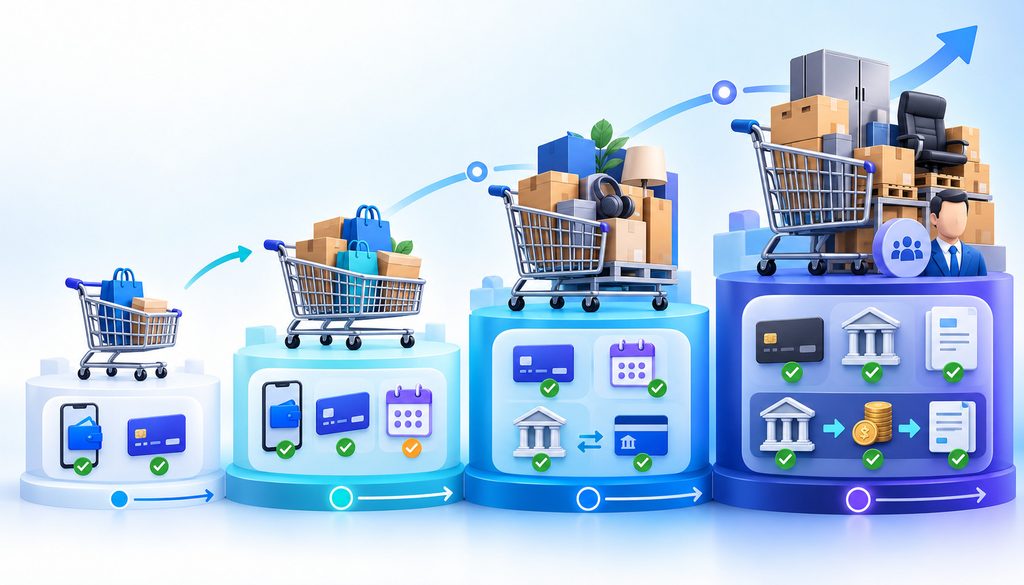
There is no official card-network rule saying BNPL belongs above a particular dollar amount or bank payments should appear only above another threshold.
Ticket-size ranges should be treated as testing hypotheses.
| Order value | Strong starting options | Options to test | Primary objective |
| Under $50 | Wallets + cards | PayPal/local method | Remove payment effort |
| 50–150 | Wallets + cards | PayPal, selective BNPL | Speed plus flexibility |
| 150–500 | Cards + wallets | BNPL, bank payment | Reduce price hesitation |
| 500–2,000 | Segment-dependent | Financing, A2A, invoice | Balance conversion and economics |
| High-ticket B2B | Bank + card/invoice | Financing where appropriate | Fit procurement workflow |
These ranges are not compliance thresholds. They are useful starting points for deciding which payment methods to offer online.
Under $50: Wallets Usually Solve a Bigger Problem Than Financing
For a low-ticket purchase, the customer’s biggest obstacle is often effort rather than affordability.
A shopper buying a $29 accessory is less likely to need installment financing than a frictionless way to complete payment without typing a full card number, expiration date, security code, billing details, and shipping information on a phone.
That makes wallets particularly relevant.
Worldpay reports that digital wallets accounted for 56% of global online transaction value in 2025, making them the leading global ecommerce payment category.
The lesson is not “show every wallet.”
It is to prioritize wallets that are relevant to the shopper’s market and usable on the current device.
Google’s official web payment documentation supports this eligibility-first approach. Its isReadyToPay() method lets an ecommerce site determine whether the Google Pay API can return a supported form of payment for the visitor before starting the payment flow.
This same principle should influence your broader payment method display order.
Do not spend valuable checkout space on a method the shopper cannot realistically use.
50–150: Test BNPL Instead of Assuming It Belongs
This is where the BNPL vs digital wallets checkout question begins to matter.
The two methods solve different problems.
A wallet mainly reduces payment friction.
BNPL changes payment timing and can reduce affordability friction.
If a customer is already willing to pay $79 today, BNPL may simply move a sale from a lower-cost card or wallet transaction into a more expensive payment route.
If the customer hesitates because the basket is becoming difficult to pay for at once, BNPL may create incremental conversion.
That difference should be measured.
Ask:
- Does BNPL improve completion among eligible customers?
- Does average order value increase?
- Do customers buy higher-margin products?
- Do returns increase?
- What is the contracted merchant fee?
- How much card or wallet volume moves to BNPL?
- Is the resulting contribution margin higher?
Do not judge BNPL only by the percentage of orders using it.
150–500: Financing Can Become More Relevant
As transaction size increases, paying the entire amount immediately becomes a larger purchasing decision.
That can make financing more relevant in categories such as electronics, furniture, travel, sporting goods, premium apparel, and home improvement.
Worldpay reports that BNPL represented about 6% of U.S. ecommerce value in 2025 and forecasts continued growth through 2030.
That is large enough to deserve serious consideration but far from evidence that every merchant should feature BNPL.
The better economic test is:
Additional gross profit from incremental orders
minus added payment cost
minus additional refunds and returns
minus fraud or dispute expense
minus operational cost
equals net value of BNPL
If the result remains positive, BNPL may deserve stronger visibility.
Processing economics should be compared across the entire payment mix, not just the advertised fee for one method. Understanding how the merchant discount rate affects total payment acceptance cost can help merchants compare cards, wallets, BNPL, and alternative rails on a more realistic cost basis.
For merchants comparing payment economics, the site’s guide to merchant discount rates provides useful background on how processing cost is built up and why headline rates do not tell the whole story.
$500 and Above: Buyer Type Matters More Than Ticket Size Alone
A $900 consumer purchase and a $900 B2B order may need entirely different payment experiences.
A consumer buying a television may prefer a wallet, card, or installment plan.
A company buying $900 of office equipment may prefer:
- ACH or another bank-payment method;
- a corporate purchasing card;
- an invoice;
- purchase-order references;
- approval before payment.
For B2B sellers, that may mean deciding whether the customer should pay during checkout at all. Businesses that routinely work with purchase orders, payment terms, or accounts receivable should compare invoicing workflows with full merchant-account payment acceptance before forcing every buyer through a consumer-style checkout.
Businesses with invoice-driven customers may also need to separate ecommerce checkout from receivables. The site’s comparison of invoicing tools and full merchant accounts explains how invoice-led payment workflows differ from real-time merchant-account acceptance.
Audience and Device Logic Should Change the Payment Mix
The strongest checkout payment method mix is often dynamic rather than fixed.
The shopper’s device, customer type, geography, history, and basket can all influence what appears first.
Mobile Customers: Reduce Typing First
Mobile checkout magnifies friction.
Entering payment and address information on a small screen is more tedious than doing the same thing with a desktop keyboard.
That makes eligible wallets valuable because they can reduce manual data entry.
Google’s current web documentation describes Google Pay as a way to let shoppers use stored payment information without manually re-entering it during checkout.
This does not mean the wallet should become the only path.
Eligibility should also be checked before giving a wallet premium checkout space. Google’s official Google Pay Web API documentation includes the isReadyToPay() method, which allows an integration to determine whether the Google Pay API can return a supported payment method for the shopper’s environment before beginning the payment flow.
Keep card entry easy to find, especially for:
- customers who do not use the displayed wallet;
- visitors on unsupported devices;
- customers using another person’s device;
- shoppers who prefer direct card entry.
A fast-payment button should reduce friction, not create another dead end.
Desktop Customers: Do Not Copy Mobile Layout Blindly
Wallets can still perform well on desktop, but the value of skipping manual entry may be lower because typing is easier and more screen space is available.
Compare actual behavior.
Useful metrics include:
- payment-method selection rate;
- completion rate after selecting the method;
- checkout duration;
- payment failures;
- authentication abandonment;
- returning-customer behavior.
Your desktop payment method display order may legitimately differ from mobile.
B2B Customers: Reconciliation Can Matter More Than Checkout Speed
B2B purchases often include requirements consumer checkout design does not.
A business buyer may care about:
- invoice references;
- purchase orders;
- bank transfers;
- ACH;
- corporate cards;
- remittance information;
- approval workflows;
- accounting-system matching.
A payment method with only 3% overall usage may still be essential if it handles large B2B orders.
Evaluate the value by segment rather than looking only at site-wide adoption.
Subscription Businesses: Evaluate the Second Payment Too
Subscription checkout has another requirement: the method must work after signup.
The initial payment is only the beginning.
Evaluate:
- recurring billing support;
- stored-credential handling;
- card replacement and expiration;
- retry logic;
- failed-payment recovery;
- cancellations;
- partial and full refunds.
A payment method that converts strongly at signup but produces weak renewal economics may be a poor long-term default.
Expanding stored-payment and recurring-payment functionality should also trigger a review of card-data exposure. Merchants should understand how their checkout architecture affects PCI compliance and the handling of cardholder data, particularly when new gateways, integrations, tokens, or payment applications are added.
As more credentials and payment integrations enter the environment, merchants should also review their card-data security scope. The site’s PCI compliance guide provides background on reducing payment-data exposure and maintaining secure acceptance practices.
BNPL vs Digital Wallets at Checkout: They Solve Different Problems
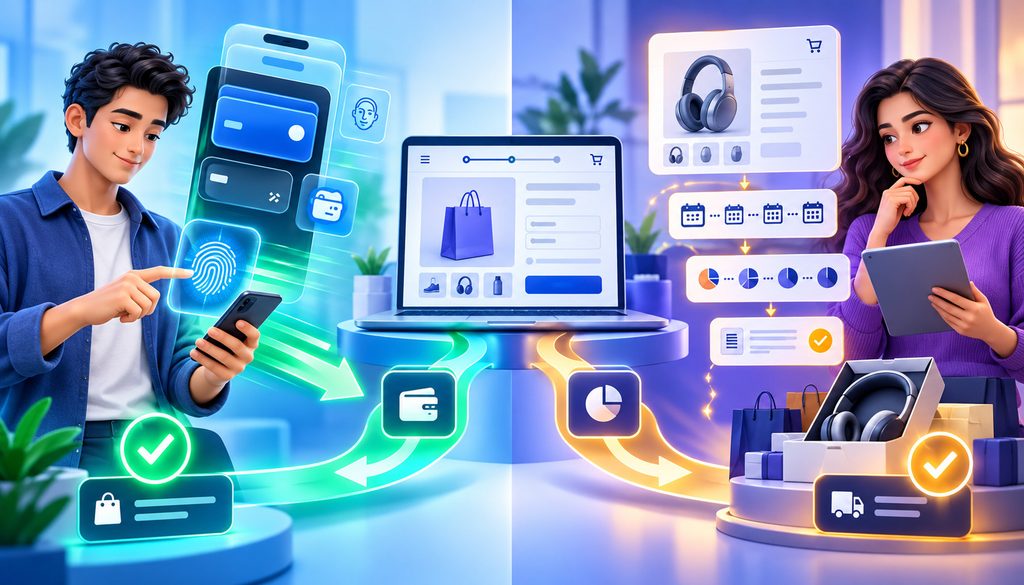
The BNPL vs digital wallets checkout comparison often assumes one should replace the other.
Usually they are complementary.
A digital wallet answers:
“How can I finish paying quickly?”
BNPL answers:
“How can I avoid paying the entire amount today?”
Those are different customer needs.
Imagine a shopper purchasing a $350 product on a phone.
Customer A already has the money or available card credit. They simply want to complete the order with minimal typing.
Customer B wants the product but prefers installments.
A wallet solves Customer A’s problem.
BNPL may solve Customer B’s.
Both can belong in the same checkout payment method mix, but they should not automatically receive the same prominence.
Think in payment roles, not logos
A useful hierarchy is:
Fast pay → standard card → affordability method → bank/economic route → long-tail alternatives
That is usually easier to understand than giving every provider its own prominent button.
Payment Method Display Order: What Should Appear First?
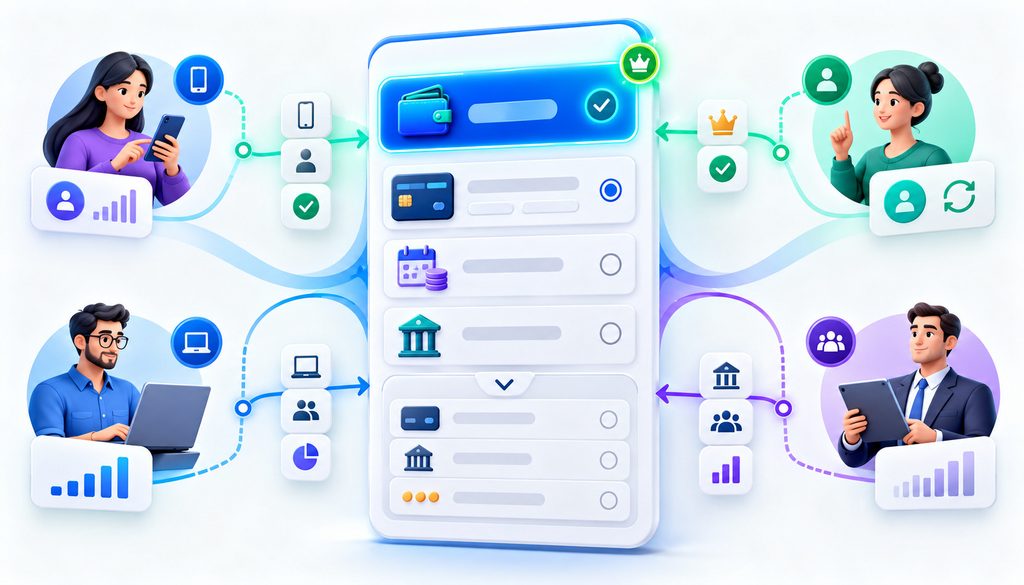
Good payment method display order combines customer eligibility with measured usage and business value.
Show only usable methods prominently
Do not show device-specific wallets to customers who cannot use them.
Do not feature a financing option that does not support the customer’s country or basket.
Do not display a bank-payment method that cannot settle in the required currency.
Eligibility should come before design preference.
Put the most likely successful route near the top
Baymard’s 2026 payment UX research recommends supporting the customer’s likely choice first while keeping alternatives easy to find. It also notes that preselecting a commonly used method can remove an unnecessary decision.
But the phrase commonly used matters.
Your store’s customer data should determine that.
Do not permanently assume cards, wallets, or BNPL should always be first.
Keep a fallback route visible
Alternative payment methods are valuable even when they are not the customer’s first choice.
A customer whose card is rejected may successfully complete through a wallet or another supported method.
Baymard specifically notes that third-party payment methods can act as a fallback when another payment route fails.
Move the long tail behind “More payment options”
This is one of the cleanest solutions to the too many payment options checkout problem.
Keep valuable niche methods available.
Reduce their visual prominence.
Remove them only when performance data shows they no longer justify their operational burden.
Should Cards Still Be the Default?
Often, but not automatically.
Baymard’s research continues to find that conventional card entry works well as the primary default on many U.S. checkouts.
Worldpay, however, reports that wallets now represent 40% of U.S. ecommerce transaction value.
Those findings are not contradictory.
One concerns checkout usability and method-selection design. The other measures transaction value.
There is another important point: wallets often use cards underneath.
Worldpay notes that in card-heavy markets such as the United States, United Kingdom, and Australia, digital wallets are frequently funded by credit and debit cards.
So “wallet versus card” may describe the checkout interface, not necessarily the underlying funding source.
Every New Payment Method Creates Operational Cost
Adding a payment method is not just a checkout change.
It creates another transaction lifecycle.
| Operational area | Cards | Digital wallets | BNPL | Bank/A2A |
| Integration | Mature | Wallet/API specific | Provider-specific | Rail/provider-specific |
| Settlement | Processor dependent | Provider/underlying rail | Contract dependent | Rail dependent |
| Reconciliation | Usually mature | Mapping may differ | Separate reports possible | References are critical |
| Refunds | Standard processor workflow | Provider rules apply | Provider-specific | Rail-specific |
| Disputes | Card-network process | Funding rail may matter | Provider-specific | Rules vary |
| Support | Familiar | Device/account questions | Financing questions | Payment-status questions |
| Engineering | Moderate | API/SDK upkeep | API/provider upkeep | Integration dependent |
Avoid blanket assumptions.
“Wallets settle instantly,” “ACH is always cheaper,” “BNPL eliminates merchant risk,” and “bank payments cannot be disputed” are not reliable universal statements.
Actual treatment depends on the provider, payment rail, geography, contract, implementation, and transaction type.
Reconciliation Can Be the Hidden Deal-Breaker
A payment method can perform well on checkout and still create an expensive finance problem.
Before adding it, determine whether finance can answer these questions quickly:
- Can the order ID be matched to settlement?
- Are fees identifiable?
- Can a refund be tied back to the original transaction?
- Are partial refunds traceable?
- Can staff distinguish pending, authorized, captured, refunded, returned, and disputed payments?
- Does accounting need another portal?
- Can transaction data be exported cleanly?
This is also where payment-system architecture matters. Connecting payment records directly to the ledger can reduce duplicate entry and make settlement matching easier; a well-designed accounting software and payment system integration can help automate invoice updates, payment posting, and reconciliation instead of creating another manual workflow.
Fraud Controls Must Expand With the Payment Mix
Every payment method adds slightly different signals and risk patterns.
When expanding the checkout payment method mix, review:
- fraud rules;
- account takeover controls;
- velocity checks;
- authentication;
- refund permissions;
- duplicate-payment protection;
- transaction evidence;
- dispute handling.
As payment options expand, merchants may also need fraud controls that evaluate more than static card rules. Approaches such as AI-driven payment fraud detection can incorporate transaction patterns, behavioral signals, and anomaly detection alongside conventional velocity and authentication controls.
Checkout strategy is also starting to extend beyond human-driven browser sessions. Merchants evaluating AI shopping agents can review the site’s current guide to agentic-commerce authorization, payment evidence, and dispute responsibility.
How to A/B Test a Payment Method Without Contaminating the Result
Payment-method testing should isolate the effect of the payment change.
If you add BNPL while simultaneously launching free shipping, redesigning checkout, changing fraud rules, and running a sale, the result tells you very little.
Define the eligible audience first
Only include customers who could realistically use the method.
For a wallet, account for device and browser availability.
For BNPL, consider:
- geography;
- currency;
- basket size;
- provider eligibility;
- product restrictions.
Randomize before payment selection
Assign eligible shoppers consistently to control or treatment.
For example:
Control: wallet + card + PayPal
Treatment: wallet + card + PayPal + BNPL
Or:
Control: BNPL under More options
Treatment: BNPL prominently displayed
The shopper should remain in the same experiment group throughout the session.
Define one primary success metric
Suitable primary metrics include:
Payment-step conversion
or
Contribution margin per checkout session
Do not use BNPL click-through rate as the primary success metric.
A high selection rate does not prove the method generated incremental sales.
Track guardrail metrics
Your checkout conversion payment options experiment should also track authorization rate, average order value, refunds, returns, fraud, disputes, customer-service contacts, processing expense, page performance, and reconciliation exceptions.
A method that increases conversion by 0.5% can still be a poor change if costs rise enough to erase the additional margin.
Do not end a test because today’s chart looks good
Estimate sample requirements before launching.
Use the store’s baseline conversion rate, minimum detectable effect, significance threshold, and statistical power.
Run the experiment through representative shopping cycles rather than stopping after a favorable day.
Segment after the main result
Once the overall test is stable, examine:
- mobile versus desktop;
- new versus returning customers;
- basket size;
- geography;
- category;
- consumer versus B2B.
You may discover that the correct answer is not “add BNPL” or “remove BNPL.”
It may be:
Show BNPL only above $250 on eligible consumer orders.
That is a much stronger payment strategy.
Example: Engineering the Mix for a $185 Average Order
Consider a consumer electronics merchant with this completed-order mix:
| Payment method | Order share |
| Direct cards | 48% |
| Digital wallets | 33% |
| PayPal | 11% |
| BNPL | 6% |
| Other | 2% |
The weak interpretation is:
“BNPL is only 6%, so remove it.”
A better review asks whether BNPL usage changes with ticket size.
Suppose analysis finds:
- below $100, BNPL adds almost no incremental conversion;
- from $100 to $249, it provides modest value;
- above $250, conversion improves meaningfully when BNPL is prominent.
The merchant can then change payment method display order dynamically.
Under $100: Wallet → Card → PayPal → More options
100–249: Wallet → Card → BNPL → More options
$250+: Wallet/Card → BNPL prominently → Other alternatives
The method remains technically supported throughout.
Only its visual priority changes.
Quarterly Checkout Payment Method Mix Review
Payment methods should not remain in checkout indefinitely just because somebody once enabled them.
Review the mix every quarter.
Track each method’s:
- eligible sessions;
- impression rate;
- selection rate;
- completed orders;
- conversion;
- average ticket;
- processing cost;
- gross margin;
- authorization failures;
- fraud;
- refunds;
- disputes;
- support tickets;
- reconciliation exceptions;
- technical incidents.
Then answer one difficult question:
Would these customers have purchased anyway?
If the answer is yes, the method may primarily be shifting volume.
If the answer is no, it is creating incremental demand.
Assign each method one action.
Promote — proven customer and economic value.
Keep — useful at the current visibility.
Demote — keep available under More payment options.
Remove — insufficient benefit for the complexity it creates.
This quarterly pruning process keeps checkout payment method mix decisions tied to actual customer behavior rather than vendor enthusiasm.
Frequently Asked Questions
What is the ideal checkout payment method mix?
There is no universal mix. For many consumer ecommerce stores, cards plus relevant digital wallets provide the foundation. BNPL, PayPal, bank payments, and other alternatives should be added according to customer demand, ticket size, geography, device mix, margins, and measured incremental conversion.
How many payment methods should I show at checkout?
Show the few options most likely to be used and keep less common methods accessible behind a secondary control. Your backend can support more payment methods than the customer sees immediately.
Which payment methods should I offer online first?
Start with broadly accepted card payments and the digital wallets relevant to your customers. Then test additional methods such as PayPal, BNPL, and bank payments according to audience and order value.
Can too many payment options hurt checkout conversion?
Yes. Current Baymard research recommends providing multiple payment options while avoiding a cluttered presentation. Lower-priority methods can remain available behind More payment options.
When should BNPL appear at checkout?
BNPL becomes most interesting when paying the full purchase price immediately is a meaningful source of customer hesitation. There is no universal ticket threshold, so use basket-size testing, conversion data, margins, fees, refunds, and return rates to determine where it adds value.
BNPL vs digital wallets: which is better?
They solve different problems. Digital wallets primarily reduce transaction friction. BNPL primarily changes payment timing. Many stores benefit from both, but their placement should depend on customer intent and order value.
Should digital wallets appear above credit cards?
For eligible shoppers, especially on mobile, prominent wallet placement can reduce data-entry effort. But card entry should remain easy to find unless your customer data strongly supports another structure.
How often should I review payment method display order?
Quarterly is a useful default. Review sooner after a major traffic shift, geographic expansion, processor change, new payment integration, or significant change in average order value.
Build the Checkout Around Customer Intent
A high-performing checkout payment method mix is not the longest list your gateway can support.
Cards provide broad acceptance. Digital wallets reduce checkout friction. BNPL can address affordability on appropriate purchases. Bank payments can make sense for B2B, high-ticket, or market-specific transactions. Alternative payment methods can also rescue sales when the shopper’s first payment attempt fails.
But every method also creates another refund path, reconciliation process, support issue, settlement workflow, and technical dependency.
Start with customer behavior.
Use ticket size to form hypotheses. Use device and audience information to decide what is eligible. Use payment method display order to keep the interface focused. Use controlled experiments to determine whether new checkout conversion payment options create incremental profit.
Then prune the mix regularly.
Promote what earns its visibility. Keep useful secondary methods accessible. Demote options that serve a narrow audience. Remove payment methods whose complexity exceeds their value.
That is how a checkout payment method mix becomes a conversion strategy rather than a collection of payment buttons.