
By Rachel Simmons October 7, 2026
Push to card payouts let businesses send money directly to eligible debit or prepaid card accounts, often within minutes instead of waiting for a conventional bank payout cycle. Visa Direct and Mastercard Send support these outbound disbursements for uses such as refunds, marketplace earnings, insurance claims, rebates, and gig-worker payments, subject to provider, issuer, compliance, and card eligibility.
For a business that regularly sends money out, payment speed can matter almost as much as payment acceptance.
A marketplace seller may have already completed an order. A delivery worker may have finished a shift. An insurer may have approved a claim. A retailer may owe a customer a refund. In each case, the business has already decided that money should move—the remaining question is how quickly the recipient can use it.
That is the problem push to card payouts are designed to solve.
Instead of asking a recipient to wait for a check or enter bank-routing information, a participating business can use an approved payout provider to push funds toward an eligible card account.
Visa Direct uses an Original Credit Transaction, commonly called an OCT, for card-based push payments. Mastercard Send, which sits within the broader Mastercard Move portfolio, also supports fast disbursements to eligible card accounts.
The technology can make a payout feel almost as immediate as a card purchase. The operational requirements, however, are very different from ordinary merchant acquiring.
A business still needs a suitable payout provider, funding arrangement, recipient-validation process, fraud controls, sanctions screening, transaction limits, reconciliation procedures, and a fallback for cards that cannot receive the payment.
What Are Push to Card Payouts?
Push to card payouts are outbound payments that credit an eligible card-linked account rather than debiting the cardholder to pay a merchant.
That direction of money flow is the most important concept to understand.
A conventional card purchase generally works like this:
Customer card → Merchant → Acquirer/processor → Card network → Card issuer authorization
The customer is paying the business.
A push payout works in the opposite commercial direction:
Business funds → Payout provider/sponsor → Card network → Recipient issuer → Recipient card account
The business is paying the recipient.
Visa defines an OCT as a transaction used to credit a recipient’s account linked to an eligible Visa card. Visa’s current developer documentation describes its Push Funds API as the mechanism for creating that credit.
This is why a business should not treat a payout as merely a card sale with a negative amount.
Purchase transaction vs. push payout
| Issue | Ordinary Card Purchase | Push-to-Card Payout |
| Money direction | Customer to merchant | Business to recipient |
| Business objective | Collect payment | Send funds |
| Visa concept | Purchase/acquiring transaction | OCT |
| Common use | Retail or ecommerce sale | Refund, rebate, claim, earnings |
| Main fraud concern | Unauthorized purchase | Payout diversion or account takeover |
| Funding source | Cardholder account | Business or platform funds |
| Accounting treatment | Merchant revenue/receivable | Business payable/disbursement |
| Operational owner | Payment acceptance team | Treasury, payouts, platform or finance team |
Keeping those workflows separate matters for reconciliation.
Your system should be able to distinguish sales, refunds, reserves, payout obligations, payout fees, rejected transactions, and completed recipient disbursements instead of placing every card-network event in the same ledger bucket.
Finance systems should separately track card sales, ordinary refunds, payout obligations, provider fees, rejected disbursements, and completed transfers. Strong payment reconciliation becomes especially important when card payouts, ACH, instant bank payments, and acquiring transactions all feed the same accounting system.
How Visa Direct Business Payouts Work
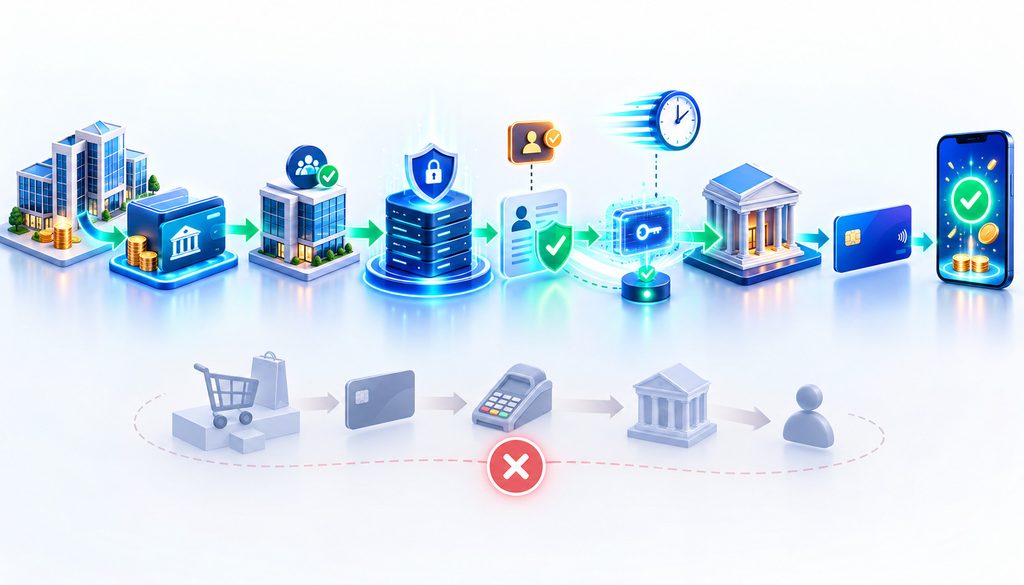
Visa Direct business payouts can use Visa Direct for Card to push money to eligible card-linked accounts.
The word eligible matters.
A Visa logo on a debit card does not automatically mean that every payout program can send money to it. Acceptance can depend on the issuer, country, account type, program configuration, use case, provider, and Visa Direct participation.
Visa provides information such as a Push Funds Indicator and Fast Funds Indicator that eligible program participants can use to help determine whether an issuer accepts OCTs and whether Fast Funds applies.
A simplified payout flow looks like this:
- A recipient becomes entitled to a payment.
- The business calculates the approved payout amount.
- The recipient selects an eligible debit card.
- The payout provider validates available account or card attributes.
- Identity, fraud, sanctions, and program controls run.
- The business submits the disbursement.
- The provider sends the OCT into Visa’s infrastructure.
- The recipient issuer receives the transaction.
- The issuer makes the approved funds available according to applicable program rules.
- The provider returns a status for reconciliation.
Visa also offers account-validation capabilities designed to help participants determine whether a card is eligible and identify conditions such as lost, stolen, or expired credentials before attempting a payout.
For businesses evaluating implementation, Visa’s own Visa Direct developer documentation is more reliable than generic claims from processor marketing pages.
How Mastercard Send Disbursements Work
Mastercard Send disbursements serve a similar commercial purpose.
Mastercard Send is now part of the broader Mastercard Move portfolio. Mastercard describes Send as enabling domestic and cross-border transfers to and from card accounts, including disbursement programs operated by banks, fintechs, acquirers, and other approved participants.
Mastercard Move extends beyond cards. Depending on the product and market, its endpoint options can include:
- card accounts;
- bank accounts;
- digital wallets;
- other supported payout destinations.
Mastercard says supported Move payments can deliver funds near real time, although actual payout methods, speed, geography, and endpoint availability vary.
Businesses researching Mastercard Send disbursements should therefore avoid assuming that Mastercard Move means one identical rail in every country.
The network may be one component inside a provider’s broader routing product.
For most merchants, the more useful purchasing question is not:
“Should I buy Visa Direct or Mastercard Send?”
It is:
“Which provider can reach the recipients we need, support our approved use cases, connect to the appropriate networks, handle compliance requirements, and give finance reliable transaction-level reporting?”
Mastercard’s current Mastercard Send developer overview is a useful starting point when validating provider claims.
What Businesses Use Push to Card Payouts For

The strongest use cases are situations where the recipient is already owed money and speed meaningfully improves the experience.
Instant refunds to debit card
Instant refunds to debit card can be particularly attractive when customers are frustrated by waiting for funds to reappear after a return or cancellation.
However, the business must distinguish a traditional refund from a separate payout.
A standard card refund usually follows the acquiring relationship associated with the original purchase.
A push payout can instead be a new outbound credit transaction.
Those processes should not run independently against the same customer obligation.
A safe workflow connects:
Original order → Original payment → Refund approval → Payout method → Payout transaction ID → Completion status
If the customer receives a push payout and the original payment system later processes another full refund, the merchant can unintentionally refund the transaction twice.
That makes idempotency and order-level payout controls essential for instant refunds to debit card.
Marketplace seller payouts
Marketplaces are another natural fit.
A seller may make several sales during the day but normally receive accumulated proceeds on a scheduled payout date. Adding an instant cash-out option can let eligible sellers access available earnings much sooner.
The key word is available.
The platform may first need to account for:
- refunds;
- commissions;
- platform fees;
- reserves;
- seller disputes;
- negative balances;
- pending orders;
- fulfillment requirements;
- suspected fraud.
The platform may first need to account for refunds, commissions, platform fees, reserves, pending transactions, and negative seller balances before making funds available. The underlying payment aggregator and dedicated processor models can also affect who controls underwriting, settlement, reserves, and merchant-level reporting.
Gig worker instant pay
Gig worker instant pay is perhaps the most recognizable example.
A delivery driver, freelancer, contractor, creator, or service worker may accumulate earnings during the day but prefer access to them before the platform’s normal weekly or biweekly schedule.
Visa specifically identifies contractor and disbursement scenarios among Visa Direct applications, while Mastercard Move supports people and business payout use cases.
For the worker, the experience may be as simple as tapping Cash Out.
Behind that button, however, the platform should determine:
- whether the work has been completed;
- whether cancellation or adjustment windows remain;
- whether tips are final;
- whether the recipient is verified;
- whether the payout credential has changed;
- whether prior withdrawals create a velocity concern;
- whether the account is under fraud review.
That is why gig worker instant pay should not be designed as an uncontrolled withdrawal button.
Insurance claim payouts
Claims are another strong use case because the recipient may need liquidity immediately.
A policyholder dealing with vehicle repairs, temporary accommodation, damaged property, or emergency replacement purchases may benefit significantly from receiving an approved payment quickly.
Visa has documented insurance claim disbursements as a Visa Direct use case, including programs designed to reduce the delay between claim approval and access to money.
The faster payment rail does not replace claim controls.
The insurer still needs to determine:
- whether the claim is valid;
- who is legally entitled to payment;
- whether sanctions concerns apply;
- whether fraud indicators require investigation;
- whether the payout amount is correct.
The instant part should begin after approval, not replace approval.
Rebates and promotional payments
Rebate programs historically depended heavily on checks and prepaid cards.
A push payout can reduce:
- printing;
- postage;
- lost checks;
- stale checks;
- replacement requests;
- customer support contacts.
The economics become important for small payments, however.
A $2 payout cost may be acceptable for a large insurance payment but unreasonable for a $10 rebate. Businesses should model the cost against the size and value of each use case.
How Fast Are Push to Card Payouts?
The safest answer is:
Usually minutes when the transaction, card, issuer, provider, and program are eligible—but never promise that every card payout will arrive at exactly the same speed.
Visa states that U.S. issuers participating in Fast Funds are required to make funds available within a maximum of 30 minutes after approving an eligible transaction. Actual availability can still depend on the receiving institution and account.
Mastercard describes supported Send transfers as near real time and says Mastercard Move can support fast payments across time zones, weekends, and holidays, depending on market availability.
That makes wording important.
Avoid:
Guaranteed instant payment in seconds.
Prefer:
Eligible instant payouts typically arrive within minutes. Availability and timing depend on the receiving financial institution, card, provider, and transaction review.
Do card payouts work on weekends and holidays?
They can.
One attraction of push to card payouts is that the underlying network is not limited to traditional bank branch hours.
Visa documents card-payout programs capable of sending funds 24/7, while Mastercard describes supported Move payments as operating across weekends and holidays.
Businesses should still test actual provider and issuer behavior before advertising a guaranteed weekend delivery time.
Push to Card vs. ACH, RTP, and FedNow

There is no universally superior payout rail.
The best business disbursement options match the rail to the recipient, transaction amount, urgency, reach, and cost.
| Payout Rail | Typical Availability | Speed | Recipient Input | Best Fit |
| Push to card | Often 24/7 when supported | Usually minutes | Eligible card credential | Consumers, sellers, gig payouts |
| Standard ACH | Banking-day settlement | Often one banking day or less | Routing + account | Routine low-cost payouts |
| Same Day ACH | Banking-day windows | Hours | Routing + account | Payroll, B2B, urgent ACH |
| FedNow | 24/7/365 | Seconds | Reachable bank account | Instant account-to-account |
| RTP | 24/7 | Seconds | Reachable bank account | Instant bank transfers |
| Check | Postal/business-day dependent | Days | Mailing details | Legacy or exception cases |
One outdated claim deserves correction.
ACH should no longer be described as universally taking “three to five business days.”
Nacha says approximately 80% of ACH Network volume settles within one banking day or less, with Same Day ACH providing faster settlement for eligible transactions.
ACH is still different from an always-on instant rail because traditional ACH depends on banking-day and processing schedules.
FedNow is designed differently. The Federal Reserve states that FedNow processes instant payments through participating institutions 24 hours per day, every day of the week, including weekends and Federal Reserve holidays.
When push to card is stronger
Push to card payouts are especially attractive when:
- the recipient already has a debit card;
- asking for routing and account numbers would create friction;
- immediate access matters;
- recipients may withdraw earnings outside banking hours;
- the payment is consumer-facing;
- card reach is stronger than the provider’s instant-bank reach.
When FedNow or RTP may be better
Instant bank rails may make more sense when:
- the recipient prefers direct bank deposits;
- both institutions are reachable;
- transaction amounts are large;
- bank-account details are already verified;
- card-payout percentage pricing becomes expensive;
- treasury prefers an account-to-account rail.
Businesses can review the Federal Reserve’s current FedNow operating information when evaluating instant bank availability.
When ACH still wins
ACH can remain the better choice when speed adds little value.
Examples include:
- scheduled vendor payments;
- routine commissions;
- ordinary payroll;
- recurring marketplace settlements;
- non-urgent rebates;
- high-volume low-margin disbursements.
A mature payout strategy therefore does not ask, “Which rail replaces ACH?”
It asks:
Which rail should handle each payout?
What Do Push to Card Payouts Cost?
There is no single published retail price that all businesses pay for push to card payouts.
Avoid statements such as:
Visa Direct costs 50 cents per payout.
or:
Mastercard Send costs 1%.
Those figures may describe one provider or contract, but they are not universal Visa Direct or Mastercard merchant prices.
Merchant-facing cost can include:
- provider transaction fees;
- fixed per-payout charges;
- percentage fees;
- sponsor-bank economics;
- card-validation services;
- recipient-verification costs;
- fraud tools;
- cross-border charges;
- foreign-exchange spreads;
- minimum monthly charges;
- API/platform fees;
- failed-payment fees.
A current public provider example illustrates the variability.
Stripe’s U.S. pricing currently lists its Global Payouts domestic debit-card option at $1.50 per payout plus 0.75% of the payout amount. That is Stripe’s product pricing—not a universal Visa Direct or Mastercard Send price.
Another provider may quote a completely different structure based on volume and risk.
That is why the best calculation is:
Total Payout Cost = Fixed Fee + Percentage Fee + Verification Expense + FX/Cross-Border Cost + Platform Cost + Exception Cost
Consider three hypothetical provider quotes:
| Payout | Provider Model | Example Cost |
| $20 | $0.50 flat | $0.50 |
| $100 | 1% | $1.00 |
| $1,000 | 1% | $10.00 |
| $1,000 | $1.50 + 0.75% | $9.00 |
These examples are illustrative only.
Percentage-based instant payout pricing becomes increasingly important as transaction size grows.
Businesses should also keep payout pricing separate from their ordinary merchant processing cost structure. Interchange, assessment fees, processor markup, and other acquiring costs relate to accepting payments, while push-to-card pricing applies to sending money out.
What Do You Need to Offer Push to Card Payouts?
Most mainstream businesses will not directly connect to Visa or Mastercard and independently launch a payout network.
Instead, they normally work through a participating bank, processor, fintech, acquirer, or payout provider.
1. A sponsoring payout provider
Your provider should confirm:
- supported payout use cases;
- supported networks;
- eligible countries;
- card types;
- transaction limits;
- settlement arrangement;
- API options;
- reporting;
- recipient-verification responsibilities;
- sanctions obligations;
- reversal and exception procedures.
Do not assume your ordinary merchant acquirer automatically supports outbound money movement.
2. A funding model
Before paying recipients, the provider needs confidence that the business can fund the transfers.
Possible arrangements include:
- prefunded payout balance;
- linked business bank account;
- platform settlement balance;
- automated treasury funding;
- reserve requirements;
- program-specific collateral.
Finance should understand funding timing before product teams promise instant availability.
3. Recipient identity and KYC controls
“KYC every person exactly like a bank customer” is too broad.
The required level of verification depends on the business model, provider, jurisdiction, recipient, account relationship, and underlying regulatory obligations.
A long-term marketplace seller or gig worker will commonly undergo more structured identity verification than a retail customer receiving a one-time approved refund.
Ask the provider to document:
- who verifies identity;
- what data is collected;
- when verification occurs;
- whether ongoing monitoring applies;
- what happens when information changes;
- who handles sanctions screening;
- which payouts require enhanced review.
4. Secure card collection
If the recipient enters debit-card information, avoid unnecessarily storing raw card credentials.
Hosted payout forms, tokenization, and provider-controlled card-entry components can reduce the amount of sensitive card data that touches your systems. Businesses that directly handle card credentials should also understand how that design affects their PCI compliance requirements and card-data environment.
5. Payout fraud controls
Receiving money and sending money create different fraud incentives.
An attacker who compromises a customer’s shopping account may attempt an unauthorized purchase.
An attacker who compromises a seller or worker account may instead:
- change the payout card;
- request an immediate withdrawal;
- disappear with the money.
Recommended controls include:
- device fingerprinting;
- login-risk analysis;
- MFA;
- new payout-method review;
- waiting periods after sensitive account changes;
- destination-card velocity;
- per-recipient limits;
- per-device limits;
- payout amount thresholds;
- impossible-travel or geolocation signals where lawful;
- duplicate payout detection;
- manual review for high-risk withdrawals.
These controls work best when the system evaluates multiple signals together rather than relying on a single transaction limit. Modern payment fraud detection can combine device behavior, login changes, velocity, transaction patterns, and payout-destination changes to identify higher-risk withdrawals before money leaves the business.
OFAC Screening and Sanctions Controls
Outbound money movement requires sanctions attention.
The U.S. Treasury’s Office of Foreign Assets Control recommends a risk-based sanctions compliance program built around management commitment, risk assessment, internal controls, testing, and training.
A payout program should document:
- which recipients are screened;
- when screening occurs;
- what information is screened;
- how potential matches are investigated;
- when a payout is rejected or blocked;
- who can override a review;
- what records are retained.
A card network or processor does not automatically eliminate the business’s own legal or contractual responsibilities.
Velocity Limits Matter More When Money Leaves the Business
A fast payout can turn account takeover into an immediate financial loss.
Consider two scenarios.
Normal activity:
A worker who has used the same device and payout card for eight months requests a $175 cash-out after completing a normal shift.
Higher-risk activity:
The same worker’s password is reset, a new device logs in from another region, a new debit card is added, and a $4,500 payout is requested five minutes later.
Those should not receive identical treatment.
Velocity rules can operate at multiple levels:
- payout amount;
- recipient;
- credential;
- account;
- device;
- session;
- day;
- hour;
- IP address;
- new-card age.
The business may also face provider or network program limits that are stricter than its internal limits.
Do Push-to-Card Payouts Have Chargebacks?
This area needs careful wording.
A push payout is not an ordinary merchant purchase, so businesses should not expect it to follow the same merchant-acquiring chargeback lifecycle as a customer disputing a retail card sale.
That does not mean a payout is risk-free or universally irreversible.
Losses can still arise from:
- account takeover;
- duplicate payouts;
- payout fraud;
- incorrect recipient information;
- provider adjustments;
- compliance actions;
- return mechanisms;
- operational errors;
- underlying contractual disputes.
Visa itself notes that a complete Visa Direct program must address transaction processing, settlement, dispute management, and reporting—not merely API submission.
Do not build a payout process around the assumption that money can simply be “charged back” from a recipient later.
The better policy is:
verify first, release second.
How to Reconcile Push to Card Payouts
Fast payments still need ordinary accounting discipline.
Every payout should have its own unique identifier and be connected to the obligation that created it.
A useful audit chain is:
Order/Claim/Earnings ID → Recipient ID → Approved Amount → Payout Method → Provider Transaction ID → Network Status → Fee → Funding Entry → Final Reconciliation
Finance should be able to answer:
- Why was this recipient paid?
- Who approved the payment?
- What amount was approved?
- Which rail was selected?
- Which recipient credential was used?
- What status did the provider return?
- What fee was charged?
- Which account funded the transaction?
- Was another payment issued for the same obligation?
Do not treat “API accepted” as the same status as “recipient received funds.”
Useful payout statuses might include:
| Status | Meaning |
| Created | Internal payout record exists |
| Under review | Fraud/compliance checks pending |
| Submitted | Sent to payout provider |
| Approved | Provider/network accepted transaction |
| Delivered | Recipient-side completion reported |
| Failed | Payout did not complete |
| Returned/adjusted | Funds or accounting entry changed |
| Reconciled | Operational and financial records match |
How to Launch Push to Card Payouts: Eight-Step Workflow
1. Separate your use cases
Do not combine every outbound payment into one launch.
Segment:
- refunds;
- gig earnings;
- seller settlements;
- insurance claims;
- rebates;
- commissions;
- contractor payments.
Each requires different controls.
2. Measure the value of speed
Find out how many recipients actually need instant access.
If only 12% choose instant payout, offering free ACH plus optional instant card payout may produce better economics than forcing every payment onto the faster rail.
3. Compare providers
Ask every candidate for:
- Visa coverage;
- Mastercard coverage;
- issuer reach;
- eligibility tools;
- pricing;
- funding rules;
- fraud tools;
- recipient verification;
- reporting;
- support procedures.
4. Model payout costs by transaction size
Test at least:
- $10;
- $25;
- $100;
- $500;
- $1,000;
- $5,000.
A percentage fee that looks harmless on a small payment can become material on larger payouts.
5. Validate recipient eligibility before promising instant payment
Do not show “instant payout available” merely because the customer entered a debit-card number.
Use provider eligibility tools where available.
6. Build account-takeover controls
Pay special attention to:
- password resets;
- new devices;
- email changes;
- phone changes;
- payout-card changes;
- unusually large withdrawal requests.
7. Build a fallback rail
A failed push to card payout should not strand the recipient.
Possible fallbacks include:
- ACH;
- Same Day ACH;
- FedNow;
- RTP;
- replacement check;
- manual payout review.
Make sure retries cannot create duplicate payments.
8. Test reconciliation before scaling
Test:
- approved payouts;
- declines;
- timeouts;
- duplicate API requests;
- ineligible cards;
- funding shortages;
- weekend transactions;
- manual adjustments;
- payout-card changes;
- suspected fraud.
A payout product is not ready merely because the happy-path API call works.
Which Business Disbursement Options Should You Offer?
A good payout program usually offers more than one method.
Choose push-to-card when:
- the recipient values speed;
- eligible card reach is strong;
- the payment is consumer-oriented;
- debit-card entry is easier than bank onboarding;
- weekend availability matters.
Choose ACH when:
- cost matters more than immediacy;
- payments are scheduled;
- the business sends large batches;
- bank information is already available.
Choose FedNow or RTP when:
- instant bank payment is preferred;
- receiving-bank reach is available;
- the amount makes percentage card-payout pricing unattractive;
- direct bank settlement fits treasury operations.
Maintain checks when:
- recipients cannot use electronic options;
- regulations or contracts require them;
- exception handling requires a paper fallback.
These business disbursement options are complementary, not mutually exclusive.
The best routing engine may automatically determine:
recipient preference + destination eligibility + payment size + urgency + cost + risk = payout rail
Real-World Example: Gig Platform Instant Cash-Out
Assume a delivery platform owes a worker $240.
The worker can choose:
Standard payout: free ACH on the platform’s regular schedule.
Instant option: eligible debit-card payout for an additional disclosed charge.
The platform should not send the $240 merely because the user taps “withdraw.”
Its workflow could be:
- Confirm $240 is actually available.
- Confirm no unresolved delivery adjustments exist.
- Confirm account authentication.
- Check whether the debit card was recently changed.
- Run fraud and velocity controls.
- Confirm card eligibility.
- Submit the payment.
- Show the resulting status.
- Record the payout and provider fee.
- Prevent the $240 from being paid again through the normal batch.
That illustrates why gig worker instant pay is a product, risk, treasury, and accounting workflow—not simply a faster transaction message.
Push to Card Payouts Implementation Checklist
Before launching push to card payouts, confirm:
- Approved business use case
- Sponsoring provider identified
- Visa Direct coverage confirmed
- Mastercard coverage confirmed
- Supported geographies documented
- Card eligibility checks available
- Funding method documented
- Per-payout pricing documented
- Percentage pricing documented
- Cross-border/FX costs documented
- Recipient verification responsibilities assigned
- OFAC/sanctions process documented
- Account-takeover controls active
- New payout-destination controls active
- Transaction velocity limits established
- Daily payout limits established
- Idempotency controls tested
- Duplicate payout prevention tested
- Weekend processing tested
- Failed-payment workflow documented
- Alternative payout rail available
- Customer disclosures reviewed
- Support escalation documented
- Daily reconciliation operational
Frequently Asked Questions
What are push to card payouts?
Push to card payouts are outbound payments sent to eligible card-linked accounts instead of being collected from the cardholder. They are commonly used for seller earnings, contractor payments, rebates, claims, and refunds.
What is a Visa Direct OCT?
OCT stands for Original Credit Transaction.
Visa uses the transaction to push funds into an eligible recipient account associated with a Visa card. It moves value in the opposite commercial direction from a typical merchant purchase.
How quickly does Visa Direct pay?
Eligible Fast Funds transactions can make money available very quickly.
Visa says participating U.S. issuers subject to Fast Funds requirements must make approved funds available within a maximum of 30 minutes. Actual availability can still vary based on financial institution, account, region, and compliance factors.
What are Mastercard Send disbursements?
Mastercard Send disbursements allow approved participants to send funds to supported card accounts. Mastercard Send is now part of Mastercard Move, which also supports other money-movement endpoints depending on market and product availability.
Can push-to-card payments arrive on weekends?
Yes, supported programs can operate outside traditional banking hours, including weekends and holidays. Actual availability still depends on the program, destination institution, card, provider, geography, and any review process.
How much do push to card payouts cost?
There is no universal rate.
Provider pricing may combine flat transaction fees, percentages, verification charges, cross-border fees, FX, or platform fees. Businesses should obtain actual quotes and model several payout amounts before selecting a provider.
Can I send money to any debit card?
No.
The destination card and issuer need to support the relevant transaction, and your provider needs to support that destination and use case. Eligibility checking should happen before an instant payout is promised.
Is push-to-card faster than ACH?
Often, but the comparison needs context.
Card push payments can arrive within minutes. Same Day ACH can settle within hours, and a large percentage of ordinary ACH volume settles within one banking day or less. ACH can still be less expensive for routine payouts.
Is push-to-card better than FedNow?
Not universally.
Push-to-card may offer convenient consumer reach through existing debit cards. FedNow offers instant bank-account payments through participating U.S. financial institutions and operates 24/7/365. Which is better depends on reach, recipient preference, pricing, transaction size, provider support, and risk controls.
What is the biggest operational risk?
Account takeover is one of the most important risks.
A criminal who compromises a seller or worker account may try to change the payout destination and cash out immediately. Strong authentication, destination-change controls, velocity limits, and anomaly detection are therefore essential.
Final Takeaway: Push to Card Payouts Work Best When Speed Is Worth Paying For
Push to card payouts can turn an approved outbound payment into usable money much faster than many traditional disbursement workflows.
That is valuable for Visa Direct business payouts, Mastercard Send disbursements, marketplace seller withdrawals, gig worker instant pay, insurance claims, rebates, and instant refunds to debit card.
But faster payment movement does not eliminate payout operations.
Businesses still need to answer:
- Who is entitled to the money?
- How was the recipient verified?
- Can the destination receive the payout?
- Has the payout method recently changed?
- Does the transaction trigger sanctions or fraud concerns?
- What does the provider charge?
- What happens if the payout fails?
- How is the payment reconciled?
- How do we prevent a duplicate?
That is why the strongest business disbursement options usually form a multi-rail strategy rather than forcing every payment through one network.
Use push to card payouts when immediate access creates genuine value. Keep ACH available when cost matters more than seconds. Add FedNow or RTP when instant account-to-account delivery is a better fit.
The result is not merely a faster payout button. It is a controlled disbursement system that chooses the right rail for the recipient, the transaction, the risk, and the economics.